
Closed-die forging for valve manufacturers
Forged valve components for OEM manufacturers
Ludon Forge manufactures forged valve components in carbon and stainless steel, with one-piece ball valve bodies at the centre of our production. We supply forged blanks, rough machined blanks and finish machined parts to customer drawings, with forging, heat treatment, blasting and CNC machining on our own site in Liaocheng, China.
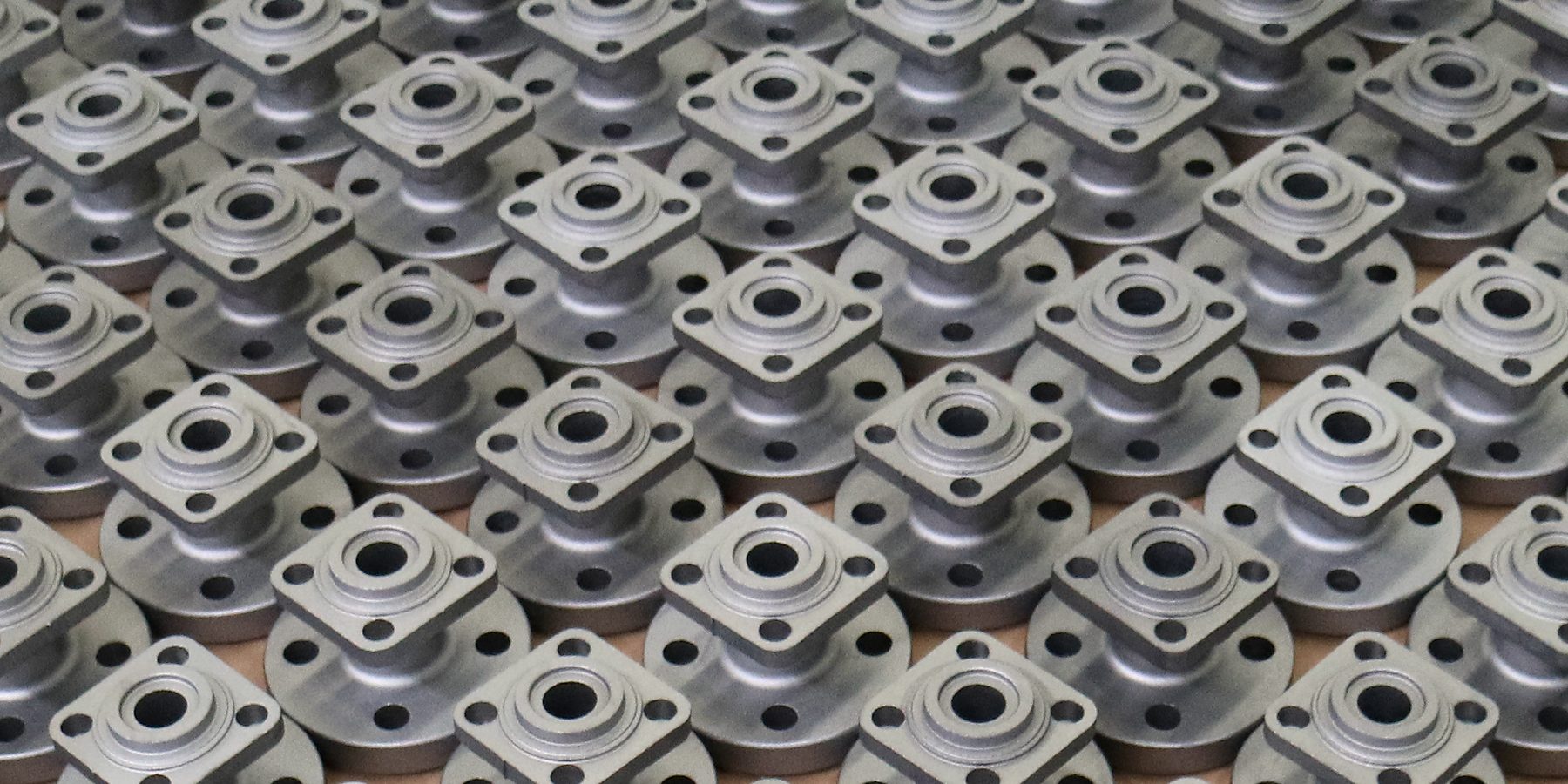
Forged valve parts we supply
Our standard programme focuses on ball valve body forgings. We also review related valve parts against the customer's drawing, material specification and annual quantity.
| Component | Supply scope |
|---|---|
| Ball valve bodies | One-piece closed-die forgings; standard body programme NPS ½″–4″ (DN15–DN100). |
| Bonnets and caps | Custom forgings reviewed to the customer's geometry, material and machining requirements. |
| End connections and connecting flanges | To customer drawings, with forging and machining scope agreed before quotation. |
| Other custom valve components | Drawing review to establish forgeability, die design and an appropriate supply condition. |
What is a forged valve body?
A forged valve body is the metal housing shaped from solid billet under compressive force. After machining, it accommodates the valve's flow passage and internal components. In a ball valve, the body provides the housing for the ball and seats and the connection for the stem.
A body blank is the forging before final machining. The finished body, seats, seals and other components must meet the valve maker's design and testing requirements before the assembled valve enters service.
Forged ball valve bodies: what we supply
Our core product is the forged ball valve body blank: a pressure-containing body forging made in one piece from certified billet. The parts are used by valve makers who need a repeatable forged starting point for CNC machining and final valve assembly.
Typical supply includes forged blanks, rough machined blanks with stock left on critical faces, and finish machined parts when the customer provides the drawing and machining requirement.
Forged valve body materials and size range
| Material | Common standard | Size range | Typical use |
|---|---|---|---|
| A105 carbon steel | ASTM A105 | NPS ½″–4″ (DN15–DN100) | Oil, gas, water and general industrial service |
| 304 stainless steel | ASTM A182 F304 | NPS ½″–4″ (DN15–DN100) | General corrosion-resistant valve service |
| 316 stainless steel | ASTM A182 F316 | NPS ½″–4″ (DN15–DN100) | More corrosive media and marine environments |
| Custom grade | To customer specification | Reviewed from drawing | Special projects and customer-owned designs |
The standard programme covers NPS ½″–4″ (DN15–DN100), full and reduced bore designs, and valve designs in ASME Class 150–300 (PN16–PN40), subject to drawing review. Material grade and nominal pressure class alone do not establish the finished valve's suitability: the valve maker must confirm the design, service temperature, fluid compatibility and applicable requirements.
Supply conditions for forged valve components
- Forged blanks: for valve manufacturers carrying out their own machining. Agree machining stock and the required heat treatment in the drawing review.
- Rough machined blanks: with the agreed allowance remaining for the customer's final operations.
- Finish machined parts: supplied to the agreed customer drawing and inspection requirements.
Optional shot blasting to ISO 8501-1 Sa 2½ is available. Specify the required surface condition with your enquiry.
In-house forging and machining capacity
Our plant has eight closed-die forging lines with 16 presses from 315 to 2,500 tonnes, more than 90 CNC lathes and 22 machining centres. Published production capacity is about two million ball valve blanks, or 12,000 tonnes, per year. See our factory and equipment and company background.
These figures describe the plant; component feasibility and delivery schedules are confirmed against each drawing and order.
How we manufacture a forged ball valve body
- Drawing and billet review. Confirm the material specification, body geometry and required supply condition before selecting billet and reviewing forgeability.
- Heating and closed-die forging. Heated billet is formed in tooling to produce the body shape. For suitable designs, multi-directional closed-die forging forms the bore and perpendicular stem boss together in one piece.
- Heat treatment. The treatment route follows the specified grade and order requirements; different materials require different routes.
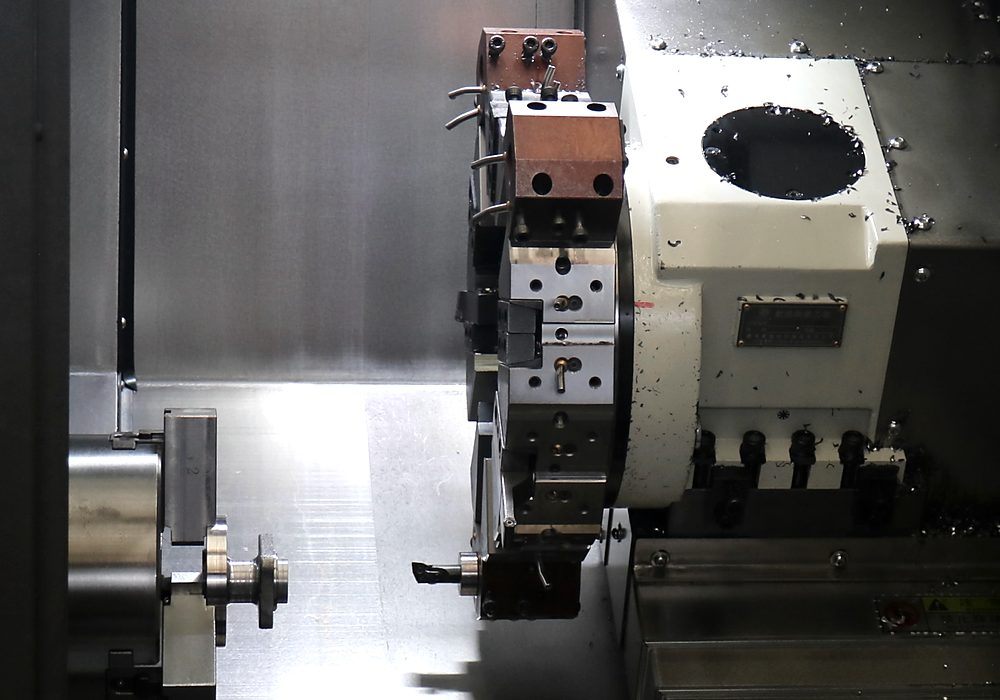
- Rough or finish machining. Turning and milling follow the customer drawing. For blanks, machining stock must be agreed around the bore, seat pockets, stem bore and connection faces.
- Surface preparation. Blasting prepares the forging surface. The required surface condition is agreed with the customer.
- Inspection and documentation. Confirm dimensions and agreed material documentation before supply. New programmes can include a first-article inspection.
Why valve makers choose forged blanks
- Closed-die forging shapes solid billet instead of pouring molten metal into a casting mould.
- One-piece forging removes a welded body joint from the pressure-containing shell.
- Near-net shape reduces machining time and raw-material waste compared with machining from solid bar.
- Repeatable die geometry helps OEM customers hold stable CNC fixtures and machining allowance.
- Material certificates and first-article inspection can be supplied for new programmes.
Forged versus cast valve bodies
Forging deforms solid metal; casting forms the body by solidifying molten metal in a mould. Closed-die forging is useful for repeated body designs where tooling, grain flow and machining stock can be planned together. Casting can suit other geometries and production requirements. The correct choice depends on the design, material, inspection requirements and total manufacturing cost.
For a one-piece forged ball valve body, there is no welded body joint. This does not replace inspection or final valve testing. Read our guide to closed-die forging advantages for a closer look at tooling and machining considerations.
Quality documentation and inspection requirements
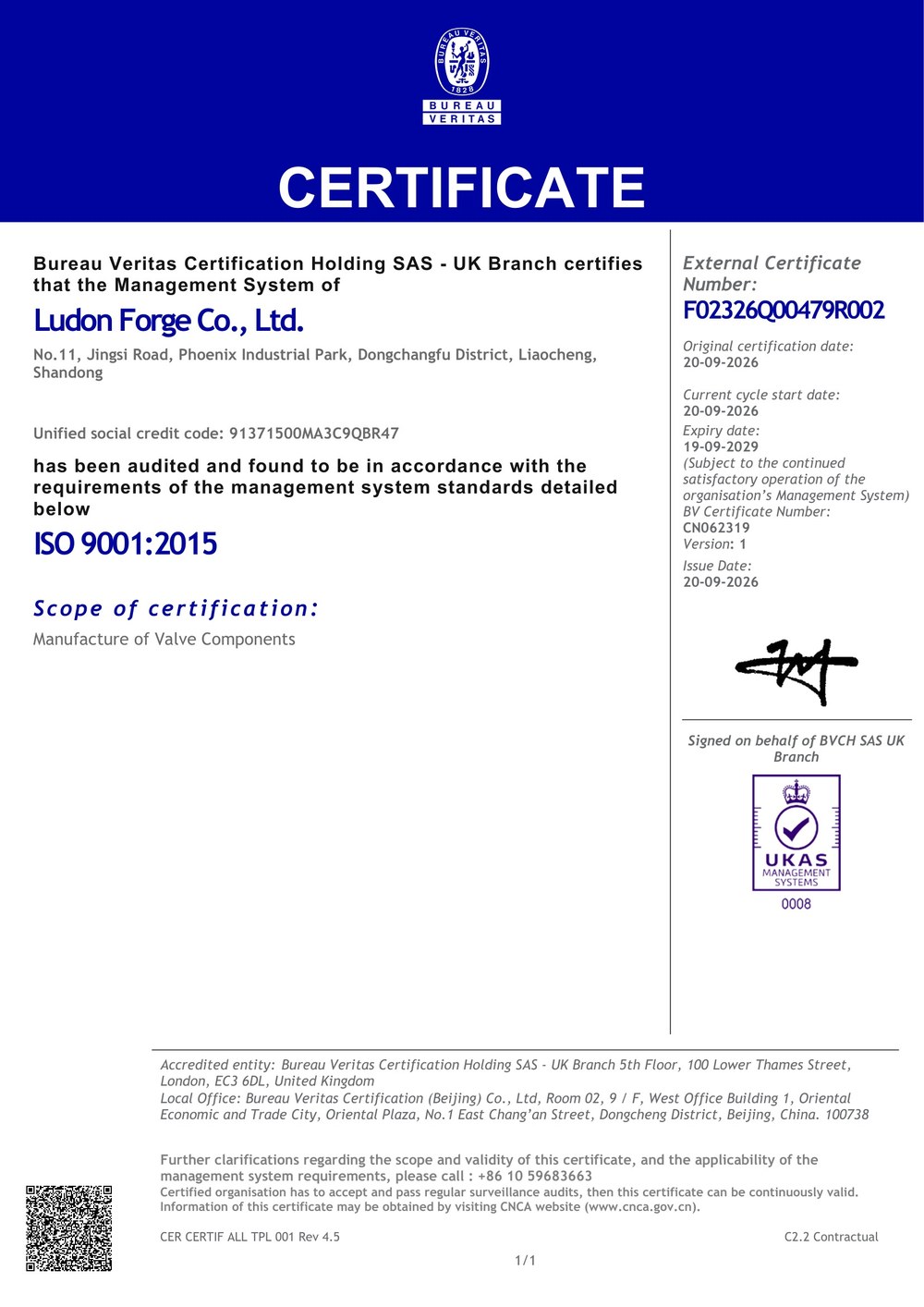
Ludon Forge's quality management system is ISO 9001:2015 certified by Bureau Veritas. See the certificate and quality information for the published certificate details. ISO 9001 certification covers the management system; it does not certify an individual valve design.
Our published supply programme includes EN 10204 3.1 material certification with every heat and first-article inspection for new programmes. Specify the documentation, dimensional checks and any additional testing needed in the enquiry so the scope can be reviewed before quotation.
Frequently asked questions
What is the difference between forged valve components, parts and bodies?
Valve components and valve parts are broad terms for the individual pieces used in a valve. A forged valve body is one of those components: the housing that contains the flow passage and supports the internal assembly. Our core production is body forgings, with bonnets, caps, end connections and connecting flanges reviewed to drawing.
Can I order a forged valve body before final machining?
Yes. We supply as-forged blanks and rough machined blanks, as well as finish machined bodies to customer drawings. Specify the supply condition and the machining allowance required for your production route.
Which materials are available for forged ball valve bodies?
Typical grades are ASTM A105 carbon steel, ASTM A182 F304 stainless steel and ASTM A182 F316 stainless steel. Other grades are reviewed against the customer drawing and specification.
What sizes does the standard programme cover?
The standard forged ball valve body programme covers NPS ½″–4″ (DN15–DN100), with valve designs in ASME Class 150–300 (PN16–PN40), subject to drawing review.
Does a body forging come with a finished valve pressure rating?
A forging is a component. The completed valve's pressure-temperature rating and acceptance depend on its design, materials, machining, assembly and testing. Include the required design and acceptance specifications with your drawing.
What are the minimum order and lead time?
Minimum order, tooling cost, sample timing and production lead time are confirmed after drawing review. Include your annual demand, initial batch quantity and required delivery date so we can assess a suitable production route.
Request a forged valve body quotation
For a fast review, send the 2D drawing or 3D model, material grade, nominal size, pressure class, expected annual quantity and required supply condition. We will review forgeability, tooling, machining allowance and delivery route before quoting.
Catalogue and certification
Review our existing capability catalogue and published quality certificate when assessing the supply programme.
Download the 2026 capability catalogue (PDF, 8 pages) · View the ISO 9001:2015 certificate
Related pages
Closed die forging advantages · One-piece multi-directional forging · About Ludon Forge